Types of Car Engines: A Simple Guide to Fuel Types and Cylinder Layouts
When you look at a car's specifications, you may see terms such as 1.5-litre turbo petrol, 2.0-litre diesel, inline-4, V6, V8, boxer or W12.
But what do these terms actually mean?
The important thing to understand is that fuel type and cylinder layout are two different ways of describing an engine.
For example, a car can have a turbocharged petrol inline-4, a turbocharged diesel inline-6, or a petrol V8.
The fuel determines what the engine burns and how combustion takes place, while the cylinder configuration describes how the cylinders are arranged inside the engine.


What Is a Car Engine?
A conventional car engine is an internal combustion engine (ICE). Fuel burns inside the engine's cylinders, creating expanding gases that push pistons. The pistons transfer this movement through the connecting rods and crankshaft to produce rotational power that eventually reaches the wheels.
Most modern petrol engines use spark ignition, while conventional diesel engines use compression ignition.
In simple terms:
Fuel + Air → Combustion → Piston Movement → Crankshaft Rotation → Vehicle Movement
1. Types of Car Engines by Fuel
The first way to classify an engine is by the fuel or energy source it uses.
Petrol Engines
Petrol, also called gasoline, engines normally use spark plugs to initiate combustion.
The fuel and air mixture is compressed inside the cylinder and the spark plug provides the ignition.
Advantages of petrol engines
- Smooth and relatively quiet operation
- Good throttle response
- Suitable for city and highway driving
- Generally lighter than comparable diesel engines
- Available in small, medium and high-performance configurations
Petrol engines are commonly found in hatchbacks, sedans, SUVs, sports cars and luxury cars.
Diesel Engines
Diesel engines use compression ignition rather than spark plugs. Air is compressed to a high temperature, and diesel fuel is injected into the hot compressed air, causing it to ignite.
Diesel engines are particularly valued for their torque, efficiency and suitability for heavy-duty applications.
Common applications
- SUVs
- Pickup trucks
- Commercial vehicles
- Buses
- Long-distance vehicles
Modern diesel engines also use sophisticated emission-control systems to reduce pollutants such as particulate matter and nitrogen oxides.
CNG Engines
CNG means Compressed Natural Gas.
CNG vehicles use natural gas stored under high pressure. CNG can be used in dedicated natural-gas vehicles or in some bi-fuel systems that can also use petrol.
Advantages
- Potentially lower fuel cost
- Lower emissions of some pollutants compared with conventional fuels
- Useful for high-mileage driving
However, CNG vehicles can have less range than comparable petrol or diesel vehicles because less energy can be stored in a similarly sized tank.
Flex-Fuel Engines
Flex-fuel vehicles (FFVs) are designed to run on petrol and ethanol-petrol blends.
For example, some FFVs can operate on gasoline or blends containing up to 83% ethanol, depending on the vehicle and fuel specification.
The engine management system adjusts fuel delivery and other parameters according to the fuel being used.


Other Automotive Fuels
Depending on the vehicle and market, internal-combustion engines can also be designed or adapted for fuels such as:
- LPG / propane
- Ethanol
- Biodiesel
- Renewable fuels
- Hydrogen in specialised combustion-engine applications
Alternative-fuel vehicles include technologies using natural gas, ethanol, biodiesel, hydrogen and other energy sources.
2. Types of Car Engines by Cylinder Layout
This is where terms such as Inline-4, V6, V8 and Boxer-6 come in.
A cylinder is the chamber in which the piston moves and combustion takes place.
The number tells you how many cylinders the engine has.
The layout tells you how those cylinders are arranged.
For example:
Inline-4 = 4 cylinders arranged in one row
V6 = 6 cylinders arranged in two banks forming a V
V8 = 8 cylinders arranged in two banks forming a V
Flat-6 / Boxer-6 = 6 cylinders arranged horizontally in opposing banks
3. Inline Engines
An inline engine, also called a straight engine, has all its cylinders arranged in a single row.


Common configurations
- Inline-3 / I3
- Inline-4 / I4
- Inline-5 / I5
- Inline-6 / I6
Inline-3
A compact three-cylinder design commonly found in small cars.
Inline-4
The inline-4 (I4) is one of the most common passenger-car engine layouts.
It offers a useful combination of:
- Compact size
- Reasonable manufacturing cost
- Good fuel economy
- Adequate performance
Inline-6
The inline-6 (I6) is known for smooth operation and is used in many performance and luxury vehicles.
It can provide strong performance while maintaining a relatively simple cylinder-bank arrangement.
4. V Engines
A V engine has two banks of cylinders arranged at an angle, creating a shape that resembles the letter V.


The number after the V represents the total number of cylinders, not the number on each side.
V6
A V6 has six cylinders, normally arranged as two banks of three.
It is popular in:
- SUVs
- Luxury cars
- Performance cars
- Larger sedans
V8
A V8 has eight cylinders, normally arranged as two banks of four.
V8 engines are associated with:
- High performance
- Strong torque
- Sports cars
- Performance SUVs
- Pickup trucks
- Luxury vehicles
V10
A V10 has ten cylinders.
It is less common than V6 and V8 engines but has been used in high-performance and supercars.
V12
A V12 has twelve cylinders arranged in two banks.
V12 engines are known for their smooth power delivery and have traditionally been used in high-end luxury cars and exotic performance vehicles.
Is a V4 the Same as an Inline-4?
No.
A V4 has four cylinders arranged in two banks, while an inline-4 has all four cylinders in one row.
However, there is an important point: V4 engines are relatively uncommon in modern passenger cars. When people talk about four-cylinder car engines today, they usually mean an inline-4, not a V4.
So:
| Engine | Cylinders | Arrangement |
|---|---|---|
| I3 | 3 | One row |
| I4 | 4 | One row |
| V4 | 4 | Two V-shaped banks |
| I5 | 5 | One row |
| I6 | 6 | One row |
| V6 | 6 | Two V-shaped banks |
| V8 | 8 | Two V-shaped banks |
| V10 | 10 | Two V-shaped banks |
| V12 | 12 | Two V-shaped banks |
Important: More cylinders do not automatically mean more power. Power also depends on engine displacement, turbocharging, compression, fuel system, engine design, tuning and many other factors.
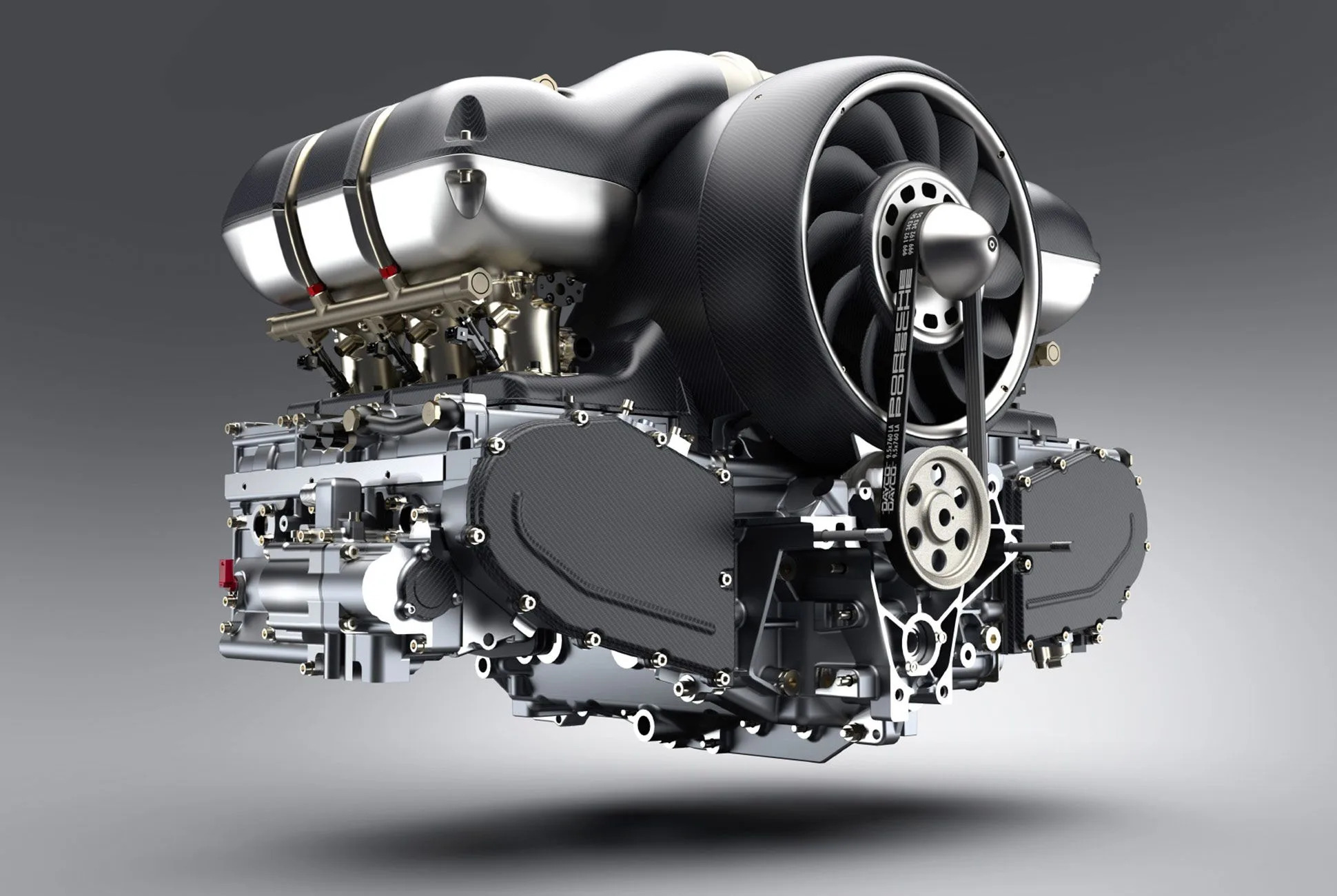
5. Boxer or Flat Engines
A flat engine has cylinders arranged horizontally on opposite sides of the crankshaft.
A true boxer engine has opposing pistons moving toward and away from each other, giving the design its name.


Common configurations include:
- Flat-4 / Boxer-4
- Flat-6 / Boxer-6
Advantages
- Low centre of gravity
- Good balance characteristics
- Distinctive engine sound
- Can benefit vehicle handling through a lower engine position
Boxer engines are particularly associated with certain sports and performance vehicles. Engine configuration can significantly influence vibration, balance and sound characteristics.
6. W Engines
W engines are more unusual.
They combine multiple cylinder banks into a compact configuration, allowing a large number of cylinders to be packaged into a relatively short engine.
Examples include:
- W8
- W12
- W16
W engines have been used in some high-performance and luxury vehicles.
A famous example is the W16, which was used in Bugatti's high-performance road cars.
7. VR Engines
A VR engine uses a very narrow cylinder-bank angle.
The design attempts to combine some of the packaging advantages of a V engine with a relatively narrow overall engine arrangement.
One well-known configuration is the VR6.
The VR6 has six cylinders but uses a narrow-angle arrangement that allows the engine to be more compact than a conventional V6 design.
8. Rotary Engines
A rotary engine is different from conventional piston engines.
Instead of pistons moving up and down inside cylinders, a rotary engine uses a rotor that moves inside a specially shaped housing.


The rotary design is compact and lightweight and is famous for its smooth, high-revving character.
However, rotary engines have different characteristics from conventional piston engines, including challenges related to fuel efficiency, emissions and sealing.
9. Turbocharged vs Naturally Aspirated Engines
Another important distinction is how air enters the engine.
Naturally Aspirated Engine
A naturally aspirated engine relies on atmospheric pressure to bring air into the engine.
It does not use a turbocharger or supercharger.
Benefits
- Simple power delivery
- Predictable throttle response
- Fewer forced-induction components
Turbocharged Engine
A turbocharger uses exhaust energy to compress incoming air before it enters the engine.
More air allows the engine to burn more fuel and potentially produce more power from a smaller displacement.
Turbocharging is widely used today because manufacturers can combine smaller engines with strong performance.
For example:
2.0L Turbo I4
means:
- 2.0L = engine displacement
- Turbo = forced induction
- I4 = four cylinders in an inline configuration
These terms describe different characteristics of the same engine.
10. Hybrid Powertrains
Hybrid vehicles combine an internal combustion engine with an electric motor and battery system.
A hybrid could therefore have:
Petrol + Inline-4 + Electric Motor
or:
Petrol + V6 + Electric Motor
So hybrid is not a cylinder layout. It describes the vehicle's powertrain architecture.
Engine Terminology Made Simple
When you see an engine specification such as:
"3.0L Turbocharged Inline-6 Petrol"
it means:
3.0L → Engine displacement
Turbocharged → Uses a turbocharger
Inline-6 → Six cylinders arranged in one row
Petrol → Uses gasoline/petrol as its primary fuel
Another example:
"4.0L V8 Twin-Turbo Petrol"
means:
4.0L → Engine displacement
V8 → Eight cylinders in two banks
Twin-Turbo → Two turbochargers
Petrol → Petrol/gasoline fuel
Quick Comparison of Common Engine Layouts
| Engine Type | Cylinders | Main Characteristic | Typical Applications |
|---|---|---|---|
| I3 | 3 | Compact and efficient | Small cars |
| I4 | 4 | Simple and versatile | Most passenger cars |
| I5 | 5 | Distinctive sound and character | Selected performance/luxury cars |
| I6 | 6 | Smooth and powerful | Luxury/performance cars |
| V6 | 6 | Compact with good power | SUVs, sedans |
| V8 | 8 | High power and torque | Performance cars, SUVs |
| V10 | 10 | High-performance configuration | Supercars |
| V12 | 12 | Very smooth, high-performance | Luxury/exotic cars |
| Boxer-4 | 4 | Low centre of gravity | Selected sports cars |
| Boxer-6 | 6 | Low, balanced configuration | Selected sports cars |
| W12 | 12 | High-cylinder-count compact layout | Luxury/performance cars |
| W16 | 16 | Extreme performance | Hypercars |
| Rotary | — | Rotor-based design | Specialised/performance cars |
Which Engine Is Best?
There is no single best engine type for every driver.
The right engine depends on the vehicle, driving conditions, maintenance requirements and performance expectations.
For everyday city driving
A modern petrol I3 or I4 can offer a good balance of efficiency, performance and practicality.
For long-distance or heavy-duty use
A diesel engine may be suitable where its torque and efficiency characteristics fit the application.
For performance
A turbocharged I4, I6, V6 or V8 can provide strong performance depending on the vehicle.
For luxury and high-performance cars
V8, V10, V12, flat-six and other specialised configurations may be selected for their performance, smoothness, packaging or character.
For lower-cost alternative fuel operation
A properly designed CNG vehicle can be attractive where fuel availability and operating economics make sense.
Frequently Asked Questions
What are the main types of car engines?
Car engines can be classified in several ways. Common fuel types include petrol, diesel, CNG and flex-fuel. Cylinder layouts include inline, V, flat/boxer, VR and W configurations. Rotary engines use a different operating architecture.
What does V6 mean in a car?
V6 means the engine has six cylinders arranged in two banks forming a V shape.
What does V8 mean?
V8 means eight cylinders arranged in two banks in a V configuration.
Is an I4 better than a V6?
Not necessarily. An I4 is generally more compact and can be efficient, while a V6 can provide more displacement, power and smoothness depending on the specific engine. Modern turbocharging means a smaller engine can also produce substantial power.
Is V4 better than I4?
Neither is automatically better. I4 engines are much more common in modern passenger cars because of their packaging, manufacturing and practical advantages. V4 engines are relatively uncommon in cars.
What is the difference between petrol and diesel engines?
Petrol engines generally use spark ignition, while diesel engines use compression ignition.
What is a boxer engine?
A boxer engine is a type of flat engine where opposing pistons move in opposing directions. It can provide a low centre of gravity and distinctive balance and sound characteristics.
Does more cylinders mean more power?
No. Cylinder count alone does not determine power. Displacement, turbocharging, compression, fuel delivery, engine speed, tuning and other engineering factors all matter.
What does "2.0L Turbo I4" mean?
It means the engine has approximately 2.0 litres of displacement, uses a turbocharger, and has four cylinders arranged inline.
Final Takeaway
The easiest way to understand car engines is to separate the terminology into different categories:
Fuel: Petrol / Diesel / CNG / Flex-Fuel
Cylinder layout: Inline / V / Boxer / W / VR
Cylinder count: 3 / 4 / 5 / 6 / 8 / 10 / 12 / 16
Displacement: 1.0L / 2.0L / 3.0L / 4.0L etc.
Air induction: Naturally Aspirated / Turbocharged / Supercharged
Powertrain: ICE / Hybrid / Electric / Plug-in Hybrid
So when someone says "3.0L V6 twin-turbo petrol engine," they are actually giving you several pieces of information about the same engine—not describing one single "type."
Understanding these terms makes it much easier to compare cars, understand performance specifications and identify what your vehicle needs when it comes to engine repair and maintenance.
For automotive service providers and car owners, knowing the engine type is also useful when diagnosing issues such as overheating, misfires, turbocharger problems, oil leaks, timing-system faults and loss of power. Disclaimer : This Content is AI Edited may have inaccurate data's ,Education Purpose only